Low shear polymer injection
Learn more about low shear: Technology Principles
Low Shear Polymer Injection
Introduction
Enhanced oil recovery (EOR) is a tertiary oil recovery method used to increase the amount of oil that can be extracted from a reservoir. Primary, pressure depletion, and secondary oil recovery, like water injection, only recovers 20 – 50 % of original oil in place (OOIP), so a large amount of oil is still trapped in the reservoir after conventional oil recovery processes. There are many different tertiary EOR methods, however, polymer injection and polymer flooding is the most important chemical EOR method used in sandstone reservoirs.
Polymer Injection
Inefficient oil recovery was recognized in the early 1900’s. Reservoir oil can be several orders more viscous than water. This makes it hard for the injected water to sweep trapped oil from the reservoir to the production wells. The consequence is breakthrough of the water stream to the production wells, which results in poor vertical sweep efficiency of the oil in the reservoir. In polymer flood operations, polymers like hydrolyzed polyacrylamides are used as mobility control agents to improve the macroscopic sweep efficiency of oil reservoirs. Polymers are long chain molecules composed of many repeated subunits with high molecular weight. By adding polymers, the injection stream gets more viscous than the oil. Alteration in the viscosity reduces breakthrough (fingering) of the water to the production wells, and hence increases the sweep efficiency of the oil the reservoir. Conventional water flooding with breakthrough of water is illustrated in Figure 1. In the lower figure, you can see the effect by adding polymer to the injection water. The improved sweep efficiency with polymers is also called the “piston effect” and can enhance oil recovery by 5 – 15 % compared to conventional methods.
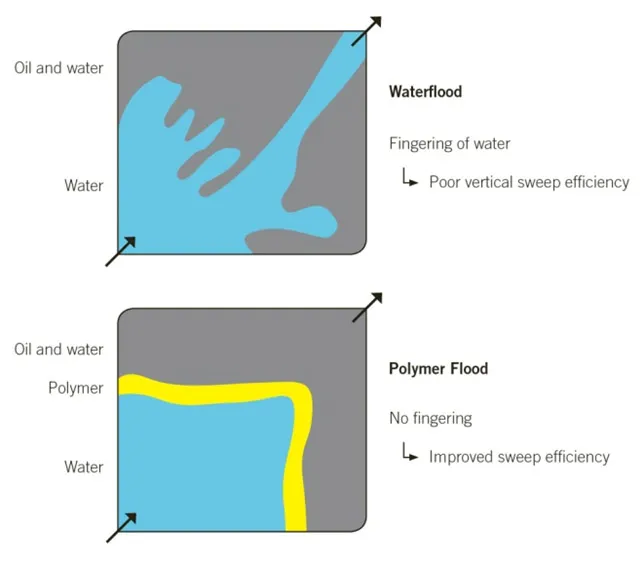
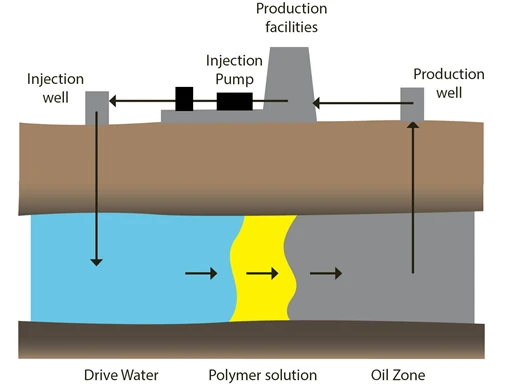
Figure 2: Illustration of a polymer flood operation
Oil recovery from a reservoir is dependent on mobility ratio, and polymer injection improves the mobility ratio. Mobility is how permeable a porous media is to a given phase, divided by the viscosity of the phase. Mobility ratio is the mobility of the displacing phase divided by the mobility of the displaced phase. In polymer flooding, water-containing polymer is the displacing phase, and oil is the displaced phase, as can be seen in Equation 1.
According to Eq. 2 and Eq. 3 this would lead to lower energy dissipation rate, and bigger maximum droplet diameter respectively.

λ Mobility
μ Viscsosity
K Effective permeability
The benefits of polymer water flooding are:
- Improved sweep efficiency of the reservoir
- Accelerated production by reduced amount of injected water that must be co-produced to attain a given level of oil recovery
- Promoted incremental oil production by increased amount of oil produced before reaching the economic water-oil ratio production limit of a field.
Mechanical Degradation of Polymers
In order to maximize the polymers viscosifying power, very high molecular weight polymers are preferred, which in turn make them very sensitive to shear degradation. Degraded polymer means that the long chain molecule is broken down, and as a consequence the molecular weight of the polymer is decreased, hence the viscosity. Shear degradation originates from chain stretching and breaking when the solution is subjected to a sudden acceleration. Such extension dominated flow fields are encountered at different locations of surface facilities (mainly in pumps, pipes and valves) and at the wellbore interface. When submitted to a flow field in which the extensional component dominates, polymer chains are stretched by the flow which results ultimately in a breakage of the polymer chains at a critical strain rate. The potential shear locations are:
- The polymer dissolution facilities (static mixers and pumps)
- The injection lines: particularly the wellhead chokes
- The well bore entry
There are a few common options to compensate for the viscosity loss due to mechanical degradation during injection:
- Inject higher concentration polymer solutions
- Use more shear stable polymers
- Use injection pumps on each well line instead of injection valves
All of the above methods will increase the cost associated with the operation, and have a negative impact on OPEX. A fourth cost efficient option is to replace the existing injection equipment with low shear technologies.

Learn more about low shear
In this section you will find some more information on different aspects of low shear. The main philosophy of low shear production is to instead of challenging the effects focus on the causes to separation problems.
Read more